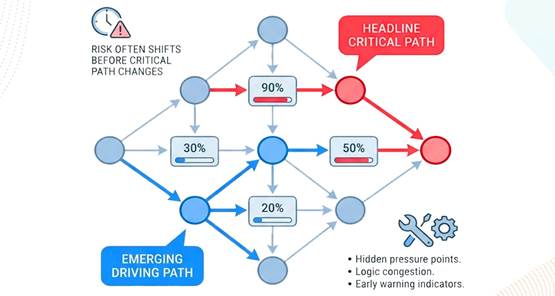
Ask most project managers where their risk is and they'll point at the critical path. It's the instinct the tools train into us: the red bars, the zero-float chain, the longest route from start to finish. Protect the critical path and you protect the date.
Except projects don't slip that politely. Time and again, the activity that blows the finish date wasn't on the critical path at all when the month started — it was sitting two days off it, in amber, ignored. The longest path is real, but it's only one chapter of the story.
Critical, driving, and near-critical — three different things
These terms get used interchangeably, and that's where the trouble starts.
- Critical path: the longest continuous chain of activities, with zero (or the lowest) total float, that determines the project finish.
- Driving path: the specific chain of relationships driving a particular milestone or activity — the predecessors actually controlling its date, which may not be the project-level critical path.
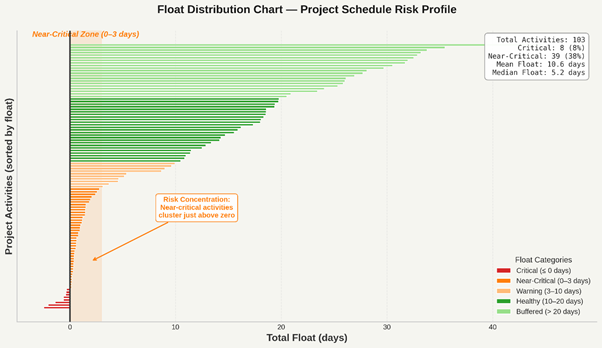
- Near-critical path: chains with a small amount of float — say, one to ten days — that become critical the instant something upstream slips.
Most schedule tools draw the first one in red and stop. The other two are where surprises come from.
How near-critical activities sink projects
Imagine a critical path with zero float and a parallel path with five days of float. You watch the red chain religiously. Then a permit on the "safe" path lands a week late. That path is now the longest one — it became critical overnight — and you never had it on your radar because last month's report drew it in amber.
This is the central trap: criticality is not a property of an activity, it's a property of a moment. A schedule has one critical path on the day you run it and a completely different one a week later. Managing only the red chain is managing yesterday's risk.
The path that fails you is rarely the one that was critical when you started watching. It's the one that became critical while your attention was elsewhere.
Total float and the illusion of buffer
Float feels like safety. It isn't — at least not the way it's usually read. Total float is shared across a chain: if a path has ten days of float spread over five activities, the first one to slip consumes it for everyone behind it. The "buffer" you thought protected activity five evaporated when activity one ran late.
Worse, high float is often an artifact of broken logic, not genuine slack. An activity floating 80 days from now usually isn't 80 days safe — it's missing a successor, and the network simply has nothing to pull it forward. Reading that as buffer is how teams relax on exactly the wrong activities.
Multiple critical paths under resource constraints
The textbook critical path assumes infinite resources — that any number of activities can run in parallel. Real projects don't work that way. The moment two parallel chains need the same crane, the same crew, or the same inspector, they're no longer independent. A resource-constrained schedule can have several effective critical paths that the time-only calculation never reveals.
This is why a schedule can pass every logic check and still be impossible: the network says two things happen at once; the site has one tower crane. The risk is real, but it lives in the gap between the CPM math and the physical job.
See the paths you're not watching
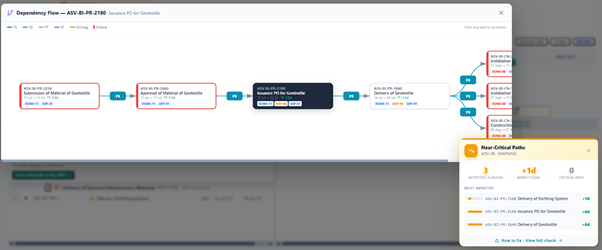
In Diagnose mode, Nahla surfaces the driving path and the near-critical activities automatically — not just the longest chain, but the ones sitting one slip away from critical. The float distribution shows you the cluster just above zero that deserves attention this week, and resource diagnostics flag where parallel chains are quietly competing for the same crew.
In Analyze mode, you can ask in plain English — "show me everything within five days of critical" or "what's driving the handover milestone?" — and get the answer grounded in the schedule, with the reasoning shown. No filtering by float band, no manual path tracing.
The takeaway
The critical path is a starting point, not a risk register. Watch the chains within a few days of it, treat shared float as the shared resource it is, and remember that the longest path changes every time you recalculate. The projects that finish on time aren't the ones that guarded the red bars — they're the ones that saw the amber bars coming.